
by Michael Caplan
“The first rule of compounding: Never interrupt it unnecessarily.” — Charlie Munger
The recent AI selloff has raised a fair question: “Is this the start of a market collapse, or a reset inside a multi-year bull market?” We believe it is a reset. What has changed is not the demand for AI, but how investors are judging the cost of financing it. Many of the people closest to the build-out see it the same way. Economists estimate that AI-related capital spending could total about $7.6 trillion from 2026 through 2031. Blackstone, which announced a $30 billion plan for AI data centers, has argued that the risk of underbuilding computing capacity outweighs the risk of a bubble. Wedbush’s Dan Ives says this season’s earnings so far “do not support the fear” and strengthen his bullish conviction on AI into 2027. Nvidia CEO Jensen Huang says supply, not demand, is the main limit on his company’s growth. None of this means a straight line up. Given the explosive growth, there will be sharp corrections even within an overall bullish trend. But a bull market that pauses to reprice its funding costs is different from one that is ending, and the biggest risk to long-term results is interrupting the strategy at the wrong moment.
The same concerns and conclusions are showing up overseas, and they are instructive. South Korea’s KOSPI, which is heavily weighted toward AI-linked chipmakers is now down more than 35% from its June peak to 5,500. Over the weekend, Goldman Sachs cut its 12-month KOSPI target from 12,000 to 9,000, citing worries about the sustainability of AI infrastructure spending and rising financing costs. But look at what the cut still says! Even at the lower target, Goldman sees more than 60% upside from current levels, and it calls Korean stocks deeply undervalued. With the index trading at about 4 times forward earnings, the lowest among major markets since 2006, this is the voice of a firm resetting its assumptions, not abandoning its conviction in the AI opportunity.
In the near term, this week is a pivotal test for markets, especially the Nasdaq. About one-third of S&P 500 companies report earnings, including Alphabet (Google) and Microsoft on Wednesday and Amazon on Thursday. Investors will be watching spending plans, with hyperscaler capital spending expected to approach $800 billion this year, and whether that spending is earning adequate returns. Last week’s jitters came from Meta, which disclosed that its long-term plans could require raising hundreds of billions of dollars. The Nasdaq fell sharply on the news, its biggest one-day drop since June. The AI debate is now less about demand than about funding, and many investors are no longer giving companies the benefit of the doubt on AI spending.
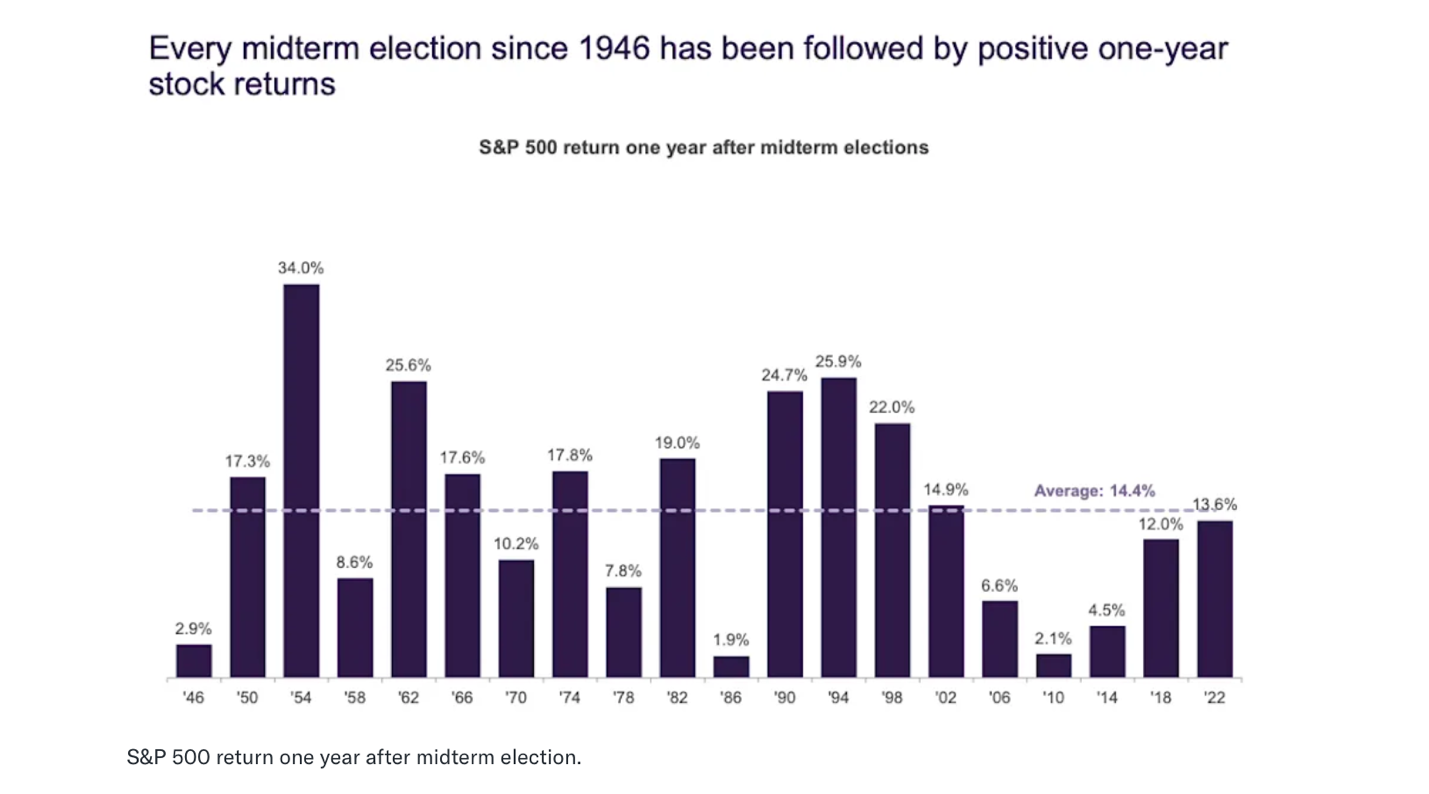
We expect market swings to persist at least until the November 3rd midterm elections. The good news thereafter: Since 1950, the S&P 500 has risen from midterm Election Day to June 30 of the following year in all 19 midterm cycles, averaging 14.4%. Sentiment toward technology is also decidedly bearish, and when pessimism is this widespread, the balance of risk and reward tends to improve. Past performance does not guarantee future results, but it is a reminder of how often the cost of stepping aside exceeds the cost of the volatility.
The economy and corporate profits remain on solid footing, which is what separates a reset from a collapse. Third-quarter S&P 500 earnings are on pace to rise more than 32% from a year ago. Jobless claims fell to 194,000, the PMI rose to 56.0 (readings above 50 signal growth), and hiring is accelerating at its fastest pace since 2012. The main caution is inflation: oil has climbed to about $116 a barrel on renewed US-Iran tensions. Rates are moving in the market’s favor. The 10-year Treasury yield has fallen from 5.36% to about 4.97%, retracing roughly half of its post-Jackson Hole jump. The Fed meets Wednesday, and a hike is unlikely: the odds have fallen from 55% to about 5%, and a move just before the midterms seems improbable. December hike odds have also dropped, from 98% to 80%, though that still leaves a hike as the likelier outcome, so we will watch Chair Warsh’s press conference for hints.
Until this week’s earnings and the Fed meeting give us more evidence, this decline has the markings of a pullback, not a breakdown. October in an election year is notoriously volatile, and Iran could be a major catalyst in either direction. De-escalation would likely lower oil, ease inflation worries and support stocks, while escalation would do the opposite. Strong results this week could turn this dip into a buying opportunity.
We take all these developments seriously. But our view is that strong earnings, falling yields and cautious sentiment make this a time to stay invested through the volatility and let compounding do its work. Our current strategy is to use dips to add to high-quality holdings.